Garden Fertilizers: A Homeowner's Guide | The Family Handyman
Here's how to fertilize plants, plus pro tips on what works best on some of the virtually popular garden plants and vegetables.
Should you lot get with granular or liquid — or maybe fertilizer spikes? Deadening release or quick release? Organic or synthetic? Exercise you even demand to fertilize and if so, when should y'all utilise it?
Fertilizing your garden shouldn't have to be and then complicated! Only with a huge variety of fertilizers on the market and different solutions for different found types, it'south difficult to know where to start.
We reached out to Diane Blazek, executive managing director at the National Garden Agency (NGB), who consulted the experts on the NGB team. They shared their expertise on fertilizing plants, including when to fertilize and how to selection the best fertilizer for your garden.
Why Fertilize Plants?
Fertilizing plants encourages healthy growth. "Call back of it as humans needing food," Blazek says. "We deplete what we take in. A vigorous one-yr plant, like annuals and almost vegetables, depletes the 'nutrient' in the soil, so nosotros need to replenish nutrients throughout the growing season."
This is especially truthful with plants growing in containers, according to the NGB experts. Nutrients tin can leach out of the soil through the bottom of the container and exit the plants starved for nutrients.
Types of Plant Fertilizers
Most all fertilizers have an NPK value, which stands for the ratio of nitrogen (N), phosphorus (P) and potassium (K) in the fertilizer mix. Information technology shows upwards every bit a series of three numbers, such as 10-15-10. An all-purpose fertilizer will typically have a counterbalanced NPK value, while specialty fertilizers accept adjusted ratios of NPK, depending on what a specific nutrient a institute needs.
Fertilizers are made with synthetic ingredients or organic byproducts similar manure, blood or bone meal, or seaweed. Which one you lot cull depends largely on personal preference. Synthetic fertilizers are more often than not fast-acting, only some gardeners prefer organic products, particularly for their food crops.
However, there are downsides to using organic fertilizers for a dwelling house garden:
- Pets may think organic fertilizer is a tasty snack;
- Organic fertilizer takes longer to piece of work, although many gardeners feel it yields improve results;
- Organic fertilizer is oftentimes more expensive than constructed.
Whether organic or synthetic, fertilizer comes in the following forms:
Granular Fertilizer
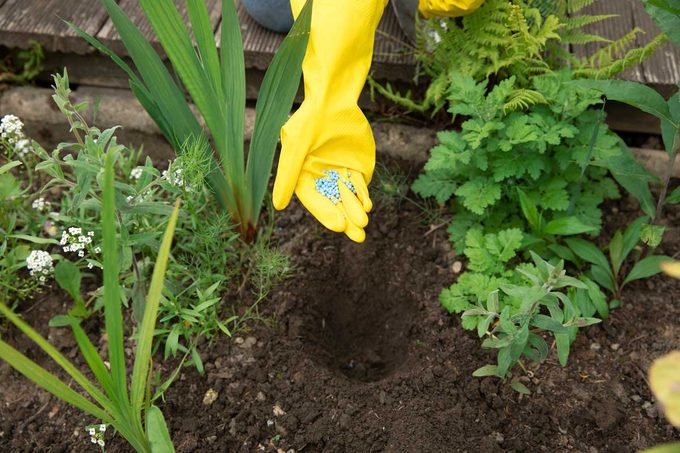
Manufactured every bit grains or pellets, granular fertilizer is applied on summit or mixed directly into the soil. It comes in two forms:
- Quick-release fertilizer dissipates into the soil when watered, but starts working right away. It needs to be reapplied every few months.
- Tiresome-release, or controlled-release fertilizer has to be worked into the soil and will release nutrients over several months.
Liquid Fertilizer
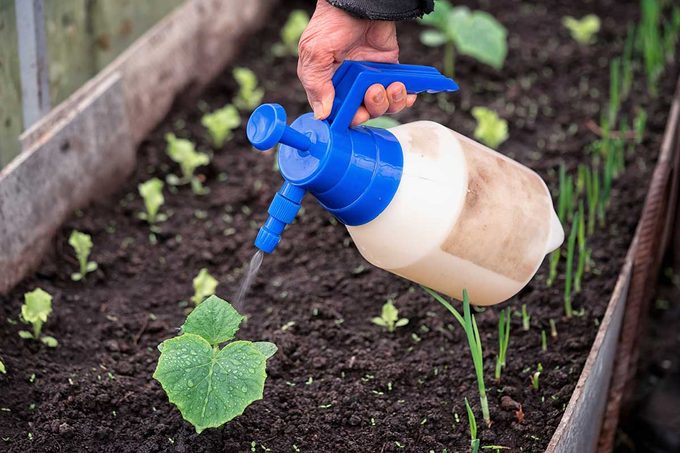
It'southward sold in two forms — a powder to be mixed with h2o, or a liquid concentrate that must be diluted with water before application. These quick-release products give fast results but need to exist reapplied during the growing season.
Fertilizer Spikes
Like slow-release fertilizers, fertilizer spikes gradually break down once they're driven into the soil. They make it piece of cake for gardeners to target specific plants with fertilizer, but are not practical for a big area.
How and When to Fertilize Specific Plants
Co-ordinate to the NGB, at that place is no specific right time to fertilize all the plants in your garden. Timing depends entirely on the type of individual plant. Fortunately, Blazek and the NGB offered us tips on when and how to fertilize some of the about popular annuals and vegetables, and which ones virtually likely need fertilizing.
Note that the term "side apparel" ways to dig a one- to 2-inch deep circular furrow just outside the circumference of the plant's leaf-spread. Use fertilizer in the trench and comprehend it with soil. In rows of vegetables, you can create long, straight furrows between the rows.
Fertilizing Your Favorite Vegetables
- Cucumbers. "Cucumbers are amid the thirstiest of vegetables and adopt long, deep watering rather than frequent sprinklings," Blazek says. "They are also heavy feeders so side dress with 5-10-10 fertilizer at the time of planting and once a month thereafter."
- Squash. "Mix in a slow-release fertilizer to the soil before planting or utilize a pre-fabricated potting mix with a deadening-release fertilizer," Blazek says.
- Peas. "Use fertilizer sparingly equally too much nitrogen can encourage more leafage product than pods," Blazek says.
- Tomatoes. "Get-go your plants off with an ample shovelful or two of compost to meliorate the soil," Blazek says. "Yous can besides utilise synthetic or organic fertilizers. Some types, such as water-soluble granules or fish emulsion, can exist applied when watering. In that location are also granular forms that are mixed with the soil before planting or used as a side dressing, and fourth dimension-release fertilizers, which can be added to the soil at planting time." For tomatoes, the NGB suggests a fertilizer that contains more phosphorus (P) than nitrogen (Northward) or potassium (K) because phosphorus promotes flowering and fruit set (when the flower starts to form into a fruit).
- Peppers. Fertilize peppers about every ii weeks, but stop fertilizing once the found is in blossom then information technology tin can put its energy into the fruit gear up.
- Eggplant. With eggplant, Blazek says to work in a balanced, time-release fertilizer with the soil at the time of planting.
Fertilizing Your Favorite Flowers and Bulbs
- Echinacea and Rudbeckia. These coneflowers come up in a range of colors and varieties and are popular for a reason — they're low-maintenance. If you lot start with a nutrient-rich potting soil mix, no boosted fertilizing is needed during the growing flavour. Blazek says fertilizing will lead to tall, leggy plants that flop over.
- Petunias. For prolific blooms, fertilize petunias every couple of weeks with a diluted liquid fertilizer solution. When deadheading or pruning, fertilize afterward to promote new growth and blooms.
- Zinnias. Zinnias aren't particularly heavy feeders, Blazek says, but fertilizing plantings at to the lowest degree twice during the growing season will yield lots of colorful blooms. "Use a counterbalanced granular or water-soluble fertilizer, for example one with 20-twenty-20 on the characterization, or mix a slow-release or organic fertilizer into the soil when y'all institute," Blazek says. For container plants, mix a timed-release or organic fertilizer into a soil-less potting mix when you constitute the zinnias, or feed them once a month with a water-soluble fertilizer or diluted fish emulsion. Always follow label directions for amounts, and be certain to dilute to the strength recommended on the characterization for containers.
- Hydrangeas. Fertilize hydrangeas in the spring equally they come out of dormancy and start to foliage out, Blazek says. Use a depression-forcefulness, balanced fertilizer, like a 5-five-5, spread out over the root ball. Information technology'due south not necessary to fertilize a second time simply if you do, do so prior to July, then hold off once more until next spring.
- Bulbs. When you lot plant bulbs, utilize a seedling nutrient with a skillful dose of phosphorus, like bone repast, in the planting pigsty. In spring, y'all can fertilize just when new greenish shoots start to announced, although Blazek says this isn't a must. Top apparel (pregnant utilize the fertilizer on the soil surface or only under the surface) with a balanced 5-ten-five, 10-10-x or 10-fifteen-ten deadening-release fertilizer. Blazek says the nearly important affair for jump-flowering bulbs is to let the leaves to remain on the plant and die back naturally, to generate and store nutrient for adjacent year'south display.
Fertilizer Pro Tips
For a garden that contains a mix of vegetables, fruits and ornamental plants, at that place's no ane-size-fits-all fertilizer. In add-on to the recommendations above, bank check the data on the plastic tags or seed packets when you do your planting. Your local nursery or abode center volition probable stock fertilizers that are suited to your climate. When in incertitude, consult an expert at a nursery.
Likewise consider these tips from the pros at the NGB:
- No affair what kind of fertilizer you lot choose, always follow the directions on the characterization.
- Applying likewise much or the wrong type of fertilizer, especially synthetics, can "burn" plants and ultimately kill them.
- Over-fertilizing vegetables and fruits will result in lush plants but niggling vegetable or fruit product.
Source: https://www.familyhandyman.com/article/garden-fertilizers/
0 Response to "Garden Fertilizers: A Homeowner's Guide | The Family Handyman"
Post a Comment